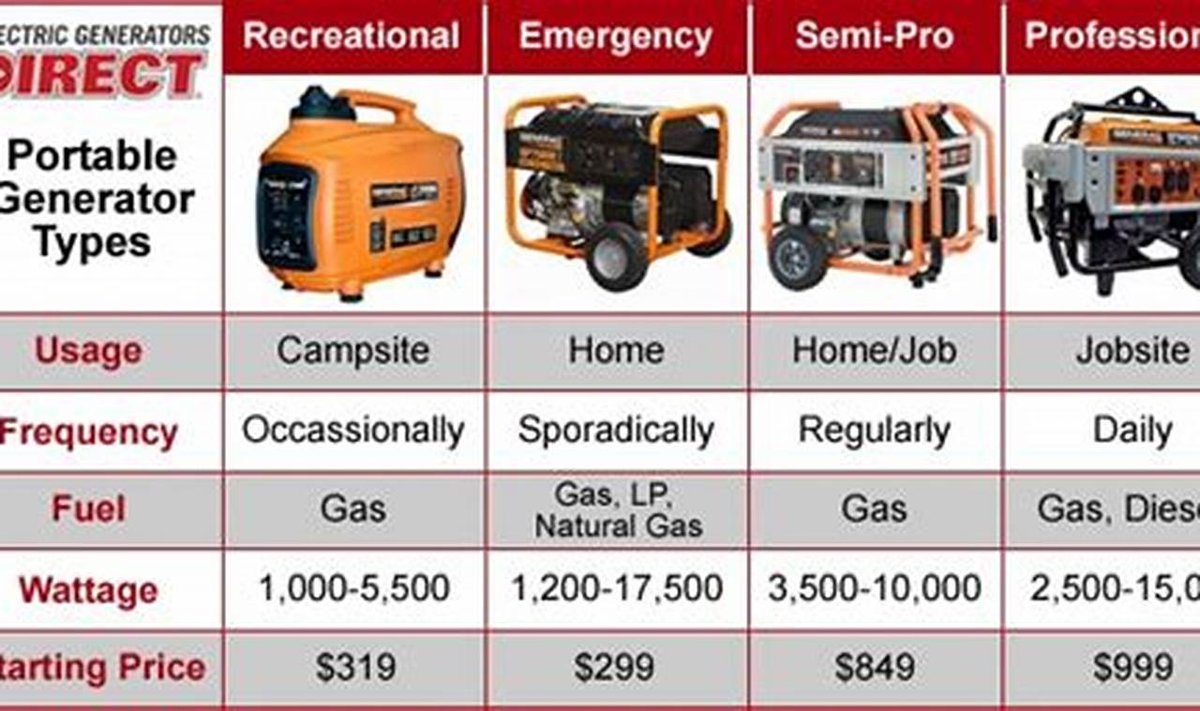
The hum of silence when the power goes out can be deafening. Suddenly, questions race: What do I need to keep running? Can a 2500W generator really cut it, or should I go bigger? Navigating the world of generators, especially when comparing a 2500W unit against its smaller or larger siblings, can feel like trying to solve a puzzle in the dark.
Here's the truth: the "best" generator size isn't a universal answer. It's a precise calculation tied directly to your specific needs. Are you looking to power a camping trip, keep essential home appliances humming during an outage, or run a small construction site? The difference between a 2500W generator and other sizes isn't just a number; it's the difference between powering a few lights and keeping your entire home comfortable.
At a Glance: Generator Sizing Essentials
- It's all about Watts: Generators are rated by their power output in watts.
- Two Kinds of Watts: You need to consider both running watts (steady power) and starting watts (the momentary surge needed to kick-start appliances like refrigerators or ACs).
- Calculate Your Needs: List everything you want to power simultaneously, then factor in the highest starting wattage of any single item.
- 2500W Sweet Spot: A 2500-watt generator is a versatile bridge, offering more than a basic portable unit but less than a full home backup. It's often ideal for camping, tailgating, or powering essential items during a minor outage.
- Bigger Isn't Always Better: Oversizing can mean higher cost, more fuel consumption, and less portability.
- Generator Types Matter: Inverter generators are quiet and safe for electronics; traditional open-frame units are louder but often more affordable for raw power.
Understanding the Core: Running Watts vs. Starting Watts
Before you can pick a generator, you need to speak its language: watts. But it's not just one number you're looking for; it's two critical figures that will make or break your power plan.
- Running Watts (or Rated Watts): This is the continuous power an appliance needs to operate steadily. Think of it as the power required to keep your refrigerator cold or your lights on.
- Starting Watts (or Peak/Surge Watts): Many motor-driven appliances (like refrigerators, air conditioners, power tools, or well pumps) require a much higher surge of power for a brief moment when they first start up. This burst of power can be 2-3 times their running wattage. Once they're running, they drop back down to their running watts.
Why this distinction matters: If your generator can't provide the necessary starting watts for your biggest appliance, that appliance simply won't turn on, even if the generator has enough running watts to power everything else. For instance, a 13,000 BTU RV air conditioner might only run on 1,200-1,800 watts, but it could demand a hefty 2,800-3,500 watts just to start. Your generator must be able to handle that initial surge.
Appliances like LED lights, phone chargers, or microwaves typically don't have significant additional starting watt requirements. It's the motors you need to watch out for.
The 2500W Generator: A Closer Look at its Capabilities
A 2500-watt generator sits squarely in the "small to medium" category, often bridging the gap between ultra-portable camping units and more robust home backup options. It's a popular choice for its balance of portability, fuel efficiency, and decent power output.
What a 2500W Generator Can Typically Power:
While exact capabilities depend on the specific appliances and their individual wattage, a 2500W generator can generally handle a good number of essential items. Think of it as a solid step up from a basic 1000-watt unit, offering more flexibility without becoming overly bulky.
You can often expect a 2500W unit to power:
- Refrigeration: A standard household refrigerator.
- Lighting: Several lights (LED or CFL are more efficient).
- Electronics: Charging phones, laptops, tablets.
- Small Appliances: A microwave (if you manage other loads), coffee maker, or toaster (one at a time, minding starting watts).
- Comfort: A few fans or even a small space heater.
- Water Management: A sump pump (crucial for basements).
- Entertainment: A TV and a streaming device.
Who is a 2500W Generator For? - Camping & RVs (Light Use): Great for running lights, charging devices, and perhaps a small portable fridge or fan in an RV that doesn't rely heavily on AC.
- Tailgating: Perfect for powering a TV, sound system, slow cooker, or electric grill.
- Small Emergency Backup: If you primarily need to keep a refrigerator running, some lights on, and communication devices charged during a short outage, a 2500W unit is a strong contender.
- Workshops/DIY Projects: Can run a few smaller power tools, though heavy-duty saws or compressors might push its limits.
For a deeper dive into this specific power output, check out Your guide to 2500 watt generators.
Comparing 2500W to Other Generator Sizes
To truly understand where a 2500W generator fits, let's stack it up against its common counterparts. Each size class serves distinct purposes, impacting everything from portability to what stays running during a blackout.
Under 2500 Watts (e.g., 1000W - 2000W): The Minimalist's Companion
Generators in this range are champions of portability and quiet operation. They're often inverter models, producing clean power safe for sensitive electronics.
- Capabilities (e.g., 2000-watt generator): A few lights, charging phones/laptops, a small refrigerator, a sump pump, a couple of fans, possibly a small microwave.
- Best For: Camping, tailgating, very light emergency backup for essential communication and minimal lighting, or powering a single essential item like a CPAP machine.
- Pros: Extremely lightweight, quiet, fuel-efficient, often inverter technology.
- Cons: Limited power means careful load management; can't run demanding appliances.
Compared to a 2500W unit, these offer less flexibility. If you need to run a fridge and a microwave, or a few more lights and a fan simultaneously, 2000W might feel restrictive, whereas 2500W gives you a bit more breathing room.
Stepping Up: The 3500W - 4000W Versatile Workhorses
This range represents a significant jump in capability, often allowing for more home comfort or robust outdoor applications.
- Capabilities (e.g., 3500-watt generator): Powers a refrigerator, lights, charges devices, drills/saws, and a small space heater.
- Capabilities (e.g., 4000-watt generator): Powers a refrigerator, a window air conditioner (usually up to 10,000 BTU), power tools, TV, and lights.
- Best For: More comprehensive essential home backup during outages, powering an RV with an AC unit (up to 13,500 BTUs is often cited for the upper end of this range), or small construction sites.
- Pros: Good balance of power and still somewhat portable; can handle an RV air conditioner, which is a common breaking point for smaller units.
- Cons: Heavier and often louder than smaller units; may still require load management if trying to run multiple high-draw appliances.
A 2500W generator simply can't handle a typical home or RV air conditioner. If keeping cool is a priority, you'll need to look at 3500W or higher. The added wattage here provides a cushion for starting larger motors and running more devices simultaneously.
Mid-Range Power: The 6500W - 8000W Comfort Creators
These generators strike a balance between significant power output and still being relatively portable (though definitely heavy). They are popular for those who want more than just the basics during an outage.
- Capabilities (e.g., 6500-watt generator): Powers a refrigerator, an air conditioner (potentially a larger window unit), multiple power tools, and lights.
- Best For: More extensive home backup, enabling several essential appliances and some comforts, powering heavier-duty tools on a job site.
- Pros: Can run multiple major appliances simultaneously; good for larger RVs or glamping setups.
- Cons: Much heavier, louder, and less fuel-efficient than smaller units.
Comparing this to 2500W, you're looking at a completely different class of generator. A 6500W unit moves beyond "essential" to "comfortable," allowing for more appliances and fewer compromises during an outage.
Heavy Duty: 10000W and Above – Whole-Home Solutions
Once you cross the 8000W threshold, you're typically looking at generators designed for significant, sustained power, often intended for whole-home backup via a transfer switch.
- Capabilities (e.g., 10000-watt generator): Can power an entire home, including refrigerators, multiple air conditioners, water heaters, and numerous devices simultaneously. Also suitable for outdoor events or job sites with heavy machinery.
- Capabilities (e.g., 12000-watt generator): Powers a central air conditioning unit, refrigerator and freezer, multiple power tools, lights, and electronics. A versatile powerhouse for comprehensive home backup or heavy-duty projects.
- Best For: Whole-house backup during extended outages, running large construction equipment, or powering large-scale events.
- Pros: Provides virtually uninterrupted lifestyle during outages; can handle almost any home appliance.
- Cons: Very expensive, very heavy (often requiring wheels or permanent installation), high fuel consumption, and much louder.
A 2500W generator is not in the same league as these powerhouses. They serve completely different needs – one for targeted, essential power, the other for comprehensive, widespread power.
Your Personal Power Blueprint: How to Calculate Your Needs
Forget guesswork. The most crucial step in choosing a generator is accurately calculating your specific power requirements. Here’s a simple, foolproof method:
- List Every Device: Make a comprehensive list of every single appliance and device you plan to power simultaneously. Be realistic. If you'll use the microwave, fridge, and lights at the same time, list them all.
- Find the Running Watts for Each: Look for the wattage on the appliance label (usually on the back or bottom), in the owner's manual, or on the manufacturer's website. If you only find amps and volts, you can estimate watts using the formula:
Watts = Volts x Amps. Sum these running watts for all devices. This gives you your Total Running Watts.
- Example: Refrigerator (600W), 3 lights (60W each = 180W), Phone Charger (10W), TV (150W). Total Running Watts = 600 + 180 + 10 + 150 = 940W.
- Identify the Highest Starting Watts: From your list, find the one appliance that demands the highest additional starting watts. This will almost always be something with a motor, like a refrigerator, air conditioner, or power tool. Appliances without motors (lights, chargers, most electronics) typically don't have a significant starting watt surge.
- Example: Your refrigerator has running watts of 600W but needs 1800W to start. This means it requires an additional 1200W above its running wattage for a brief moment. Your lights and TV don't have additional starting watts. So, your highest additional starting watts is 1200W (from the fridge).
- Calculate Total Starting Watts Needed: Add your Total Running Watts to the Highest Additional Starting Watts.
- Example: Total Running Watts (940W) + Highest Additional Starting Watts (1200W from fridge) = 2140W.
The result: You need a generator that can provide at least 2140 starting watts and 940 running watts. A 2500W generator, in this case, would likely suffice, providing enough headroom for both.
A Quick Calculation Tip: Always aim for a generator with a starting wattage capacity that is at least 10-20% higher than your calculated total starting watts. This buffer accounts for voltage drops, aging appliances, or future needs.
Beyond Watts: Generator Types & What They Mean for You
Choosing the right generator isn't just about the numbers; it's also about the technology inside. The two main types offer distinct advantages.
Inverter Generators: The Smart & Quiet Power Source
These are the darlings of campers, RV enthusiasts, and anyone needing clean, quiet power for sensitive electronics.
- Pure Sine Wave Output: Crucial for delicate devices like laptops, smartphones, medical equipment, and modern TVs. It ensures stable, high-quality power that prevents damage.
- Fuel Efficiency: Inverter generators adjust their engine speed based on the load. If you're only charging a phone, the engine idles down, saving fuel and extending run times.
- Quiet Operation: Because they don't always run at full throttle, they are significantly quieter than traditional generators, making them ideal for noise-sensitive environments.
- Portability: Often lighter and more compact, designed for easy transport.
- Ideal For: Camping, RVing, tailgating, emergency backup for homes with sensitive electronics, or quiet residential use.
A 2500W inverter generator is a popular choice for balancing power and these advanced features.
Traditional Open-Frame Generators: Raw Power on a Budget
These are often the workhorses you see on job sites or as more robust home backup solutions.
- Cost-Effective: Generally more affordable per watt than inverter generators.
- Raw Power: Designed to deliver maximum power for tools, appliances, and general use.
- Less Suitable for Sensitive Electronics: While some newer models offer improved power quality, many traditional generators produce "modified sine wave" power, which can be harmful to very sensitive electronics.
- Loud Operation: They typically run at a constant, high RPM, making them much louder than inverter models.
- Fuel Options: Commonly run on gasoline, but many also offer dual-fuel (gasoline/propane) or even natural gas conversion kits.
- Ideal For: Powering construction tools, less sensitive home appliances during an outage, or general residential/commercial use where noise isn't the primary concern.
For higher wattage needs, particularly above 5000W, traditional open-frame generators often provide the most bang for your buck.
Making the Smart Choice: Key Factors Beyond Wattage
With your wattage calculated and an understanding of generator types, a few more considerations will help you pinpoint the perfect unit.
- Primary Purpose:
- Camping/Tailgating: Focus on portability, quiet operation (inverter), and fuel efficiency. A 2500W inverter is often perfect.
- Home Backup (Essentials): Balance wattage with fuel efficiency and run time. A 2500W to 4000W unit might be ideal.
- Whole Home Backup: Larger, more permanent solutions (often 8000W+), possibly integrated with a transfer switch.
- Job Site: Durability, raw power, and fuel capacity are key.
- Portability: How often will you move it? How far? A 2500W unit is typically manageable for one person; larger units often require wheels or two people.
- Noise Level: Measured in decibels (dB), this can be a deal-breaker, especially in campgrounds or residential areas. Inverter generators are significantly quieter.
- Fuel Type & Efficiency:
- Gasoline: Most common, but has a shelf life.
- Propane: Cleaner burning, longer shelf life, but less energy-dense than gasoline.
- Dual Fuel: Offers flexibility.
- Natural Gas: Requires a direct line, often for permanent installations.
- Consider the run time at various loads, especially at 50% load, which is a good indicator of real-world use.
- Budget: Generators range widely in price. Determine your maximum spend, but remember that investing in reliability and features often pays off.
- Sensitive Electronics: If you have computers, smart TVs, or medical devices, an inverter generator providing pure sine wave power is non-negotiable.
Safety First: Essential Generator Best Practices
Having a generator provides peace of mind, but using it safely is paramount. Never compromise on these critical precautions:
- Ventilation is NON-NEGOTIABLE: Generators produce carbon monoxide, a colorless, odorless, and deadly gas. ALWAYS operate your generator outdoors, far away (at least 20 feet) from windows, doors, vents, and living spaces. Never run it in a garage, even with the door open.
- Keep it Dry: Protect your generator from rain, snow, and wet conditions. Moisture can cause electric shock or damage the unit. If necessary, use a generator tent or canopy, ensuring proper ventilation.
- Use Heavy-Duty Extension Cords: Only use outdoor-rated, heavy-gauge extension cords that can handle the generator's output. Inspect cords for damage before each use.
- Never Refuel While Running: Allow the generator to cool down completely before refueling. Gasoline is highly flammable, and spilled fuel on a hot engine can ignite.
- Keep Away from Flammables: Store fuel in approved containers away from the generator, heat sources, and ignition sources.
- Install Carbon Monoxide Detectors: Place CO detectors inside your home, even with outdoor generator use, as gas can seep indoors.
- Know Your Outlets: Only plug appliances directly into the generator's outlets or connect it to your home's electrical system via a professionally installed transfer switch. Never backfeed power into your home's electrical system by plugging the generator into a wall outlet—this is extremely dangerous and can electrocute utility workers.
- Check Run Time & Maintenance: Most generators run 8-12 hours on a full tank; plan accordingly. Regularly check oil levels and perform routine maintenance as per the manual.
Powering Your Peace of Mind: A Final Word
Choosing the right generator—be it a versatile 2500W unit or a larger whole-home powerhouse—boils down to a simple philosophy: understand your needs, do the math, and prioritize safety. The "best" generator isn't about bragging rights; it's about making sure your essential power needs are met reliably and safely when the grid lets you down.
Don't wait for the next outage to make this decision. Take the time now to calculate your specific wattage, consider your usage scenarios, and invest in the right level of power for your peace of mind.